Sara’s self-harm crisis and disposal of the knives
Dark Lies the IslandSara’s self-harm crisis culminates in a deliberate attempt to remove the knives she might use to hurt herself. After disturbing experiences inside the house and an evening of escalating distress, she carries all nine knives outside and throws them one by one into the darkness. The act does not resolve the underlying crisis, but it changes the immediate situation: she leaves the knives behind, goes to a high vantage above Clew Bay, and finds a brief spell of something like sleep.
A Crisis Intensifies
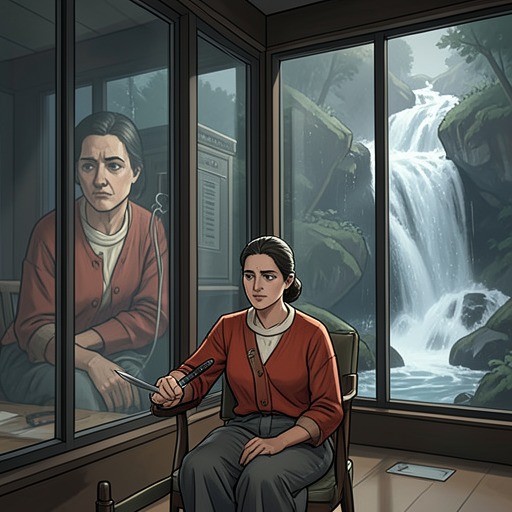
The scene follows a phone exchange with her father, whose response leaves Sara asking what his family connection has given her. After he ends the call, she switches off the lamps and goes outside in search of calm. There, she experiences an abrupt, frightening encounter: she feels herself gripped and unable to call out, then gets back inside and sees faces crowding the window before they disappear. The text presents this as a terrifying experience, not as an objectively explained intrusion.
Sara turns her phone on again and receives a message from Granada telling her to give the experience expression. The message sharpens rather than settles the strain between them: she imagines him thinking of himself as unlike other fathers. She then turns to the Sabatier knife block, whose steady sound marks her attention shifting toward the possibility of self-harm. The passage makes the risk explicit when she considers cutting the inside of her thigh, while the language of a Dark Angel gives the impulse a coercive, whispering presence without establishing that it comes from an external source.
The Decision to Remove the Knives
A sudden burst of sound from the television interrupts Sara as she crosses the room. The Beatles song “For No One” is playing for the ninth time; she remains still until it ends, reads the moment as a message, and then switches the television off. This interruption does not erase the crisis, but it precedes a consequential change in her actions: instead of using a knife, she takes every knife from the block.
She carries the set outside in several handfuls, opens the glass doors, and lets the knives fall at her feet. She then throws them one by one into the night. The first is a serrated breadknife; the others follow, disappearing into the dark and boggy ground. By removing the whole set rather than a single blade, Sara makes the decision concrete and comprehensive: the knives that had become the focus of her immediate danger are no longer within the house.
Clew Bay and a Temporary Pause
Afterward, Sara goes back inside and wraps herself in her father’s mustard-coloured duffel coat. She returns outside barefoot and walks to a high vantage overlooking Clew Bay, where she can make out the small islands in the dark. A break in the cloud briefly illuminates one of them. The passage does not present the landscape as a cure; instead, the open view and the water’s steady movement offer a contrast to the constricted, threatening interior of the house.
Sara sits on the wet ground, draws her hands around her knees, and closes her eyes. The respite is carefully measured: first a short while, then half a minute, then a full minute and more. At last, she feels something a little like sleep. The ending is therefore neither a recovery nor a declaration that the danger has passed. It is a limited reprieve, reached after Sara has acted to put the knives beyond reach.
Narrative Significance
The episode is structured around a sequence of threatened action, interruption, and substitution. The Sabatier block concentrates Sara’s attention on possible self-injury; the repeated song interrupts her movement toward it; and the knives are then carried outdoors and disposed of rather than used. The objects matter not only as symbols of danger but as things Sara can physically remove from her surroundings.
The scene also holds distress and agency in uneasy balance. Sara is frightened by what she experiences, unsettled by her father’s response, and drawn toward harming herself; at the same time, she makes a specific choice that alters the immediate conditions of risk. Throwing the knives does not explain or end her crisis, and the final moment of near-sleep remains fragile. Its significance lies in that narrow change: for a while, the knives are gone, and Sara can sit outside with the darkness of Clew Bay before her.